
Romantic Sphere Ball Sorting
Aya Hamdy shabaan DeveloperPuzzle
4.7367.00 Reviews
- Version
- 1.1.9
- Installs
- 5.00M
- Age Rating
- Mature 17+
Screenshots

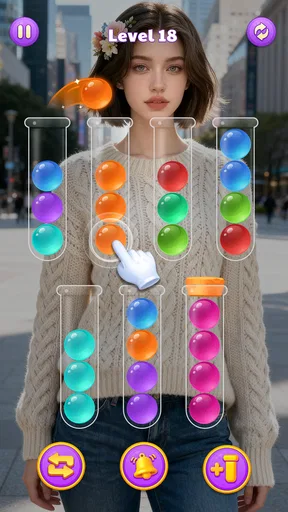


Our Review of Romantic Sphere Ball Sorting
 Analysis by Appyee
I approached Romantic Sphere Ball Sorting as a small, focused puzzle game rather than something designed to fill every spare hour with constant novelty. Its central idea is easy to understand: sort colorful spheres until the arrangement is complete. That simplicity is the main attraction. I can open it when I want a quiet mental break, understand the immediate task quickly, and close it without feeling that I have abandoned a complicated story or a long-running match.
The game comes from Aya Hamdy shabaan Developer and is available free of charge. It sits in the puzzle category, carries a Mature 17+ content rating, and has attracted over five million installs. Those figures suggest that the basic sorting concept has found a substantial audience, while the average rating of 4.7 shows that many players enjoy the experience. My own view is more measured: the game is appealing when I want calm, deliberate play, but its value depends heavily on whether I enjoy repetition and visual organization.
How the sorting experience feels in everyday play
The first thing that works well is the low barrier to entry. A sphere-sorting puzzle does not require a long tutorial to explain its purpose. I can immediately focus on the colors, the available spaces, and the order in which each move should be made. That makes it suitable for short sessions during a commute, while waiting for an appointment, or after work when I want something more engaging than scrolling but less demanding than an action game.
The calm presentation implied by the game’s concept is important. This is not the sort of puzzle I would choose for fast reflexes or competitive pressure. The appeal comes from gradually reducing disorder. Each useful move makes the board easier to read, and the satisfaction comes from seeing a mixed arrangement become organized. For me, that creates a pleasant rhythm: inspect the board, make a cautious move, reconsider the open spaces, and continue until the pattern resolves.
That rhythm also explains why the game can feel more thoughtful than its simple appearance suggests. A move that looks helpful may block access to another color or use a spare space too early. I found it more enjoyable when I treated each empty container as a limited resource rather than moving spheres impulsively. The best results come from planning the next two or three moves, not merely matching the most obvious color.
Speed expectations and the value of short sessions
Romantic Sphere Ball Sorting is naturally suited to quick starts and short bursts of attention. The individual puzzle format means I do not need to reserve a large uninterrupted period before opening it. I can play for a few minutes, pause mentally at a sensible point, and return later without needing to remember a complicated plot or a team strategy. That makes it a practical choice for people who like games that respect an irregular schedule.
Its perceived speed is also connected to the amount of thought each board demands. The game may feel immediate when the colors are easy to separate, yet slower when several stacks compete for the same temporary space. I do not consider that a performance flaw; it is part of the puzzle’s tension. A board can look almost solved and still require careful rearrangement. Players who want rapid action may interpret this as hesitation, while players who enjoy methodical decisions will probably see it as the point.
I would not install it expecting a broad collection of unrelated activities. The sorting premise gives the game its identity, but it also narrows the experience. If I want racing, combat, narrative exploration, or a puzzle game built around wordplay, this is not the right substitute. Its strength is that it stays centered on one kind of visual problem instead of constantly changing direction.
What happens during heavier use
Longer sessions reveal the main trade-off. At first, the clean sorting loop feels soothing because every board presents a manageable problem. After repeated play, the same loop can become predictable. I noticed that my enjoyment depended on taking breaks and returning with a fresh eye. When I tried to force a long session after the puzzles began to blur together, the game felt less relaxing and more like routine maintenance.
That makes it particularly useful as a reset between demanding tasks. For example, after finishing a dense piece of reading, I could use a short sorting session to shift attention without committing to a full entertainment break. The game gives my mind a concrete visual task, but it does not require the emotional investment of a story-driven game. I would avoid using it as the only game on a long journey, however, because the focused concept may not provide enough variety for hours of continuous play.
A practical habit is to stop when I begin making moves without checking the whole board. That usually means I am playing automatically rather than solving thoughtfully. Returning later often makes the arrangement easier to understand. This is one of the less obvious strengths of the format: progress depends not only on persistence, but also on the quality of attention I bring to the board.
Reliability, recovery, and the cost of a mistake
The game’s appeal depends on a stable, readable interaction. Sorting puzzles are unforgiving when a tap is unclear or when a move does not behave as expected, because a single action can change the entire arrangement. I therefore pay more attention to control confidence here than I would in a casual arcade title. Before committing to a move, I prefer to identify the destination and the color I am freeing, rather than tapping quickly and correcting myself afterward.
Recovery is best handled through patience rather than panic. When I create an awkward arrangement, I first look for a way to reopen a useful space and restore access to a buried color. That approach is more satisfying than treating every imperfect move as a failure. It also means the game can reward understanding of the board instead of simple trial and error. Still, anyone who dislikes undoing mistakes or restarting a difficult arrangement may find the experience stressful despite its calm theme.
The current version is 1.1.9, and the game has a 4.7 average from around forty-three thousand ratings, alongside hundreds of written reviews. I read those figures as evidence of strong general reception, not as a promise that every device or every player will have the same experience. A rating can tell me that the core idea works for many people, but it cannot replace testing the game on my own phone or deciding whether this particular puzzle style matches my habits.
There is also a financial point worth considering. The game is free to start, but optional in-app purchases range from $0.99 to $99.99 per item. I would be careful around any purchase prompts and decide in advance whether I want to spend anything. For a sorting game, the free entry is attractive, yet the presence of a wide purchase range means the overall cost can vary considerably depending on how a player responds to optional offers.
Device constraints and practical expectations
The game supports devices running Android 8.0 or later. That gives it a reasonably broad compatibility range, but it still matters if I am using an older phone that has limited free storage, a worn battery, or many apps competing for memory. A simple visual puzzle should be an easier workload than a modern 3D game, but I would not assume that every older device will feel identical. Background activity, system age, and screen responsiveness can all affect how comfortable repeated tapping feels.
Resource demands are easiest to judge in context. This is a focused puzzle built around colorful spheres, not a large open-world game with continuous camera movement. I would expect its basic concept to be less demanding than a high-end action title, but I would still keep the operating system requirement in mind before installing it. On a device close to the minimum supported version, I would also avoid running many other heavy apps at the same time if I wanted the smoothest possible session.
Screen size can influence the experience more than raw power. On a compact display, the board may feel visually crowded when several colors are close together, while a larger screen can make the arrangement easier to inspect. I find that rotating the phone is not something I would assume the game supports or needs; instead, I would use the orientation that presents the board most clearly and keep the screen clean of distractions. The key requirement is not gaming-grade hardware, but a display and touch response that let me distinguish colors and select containers confidently.
The Mature 17+ rating is another reason to check suitability before handing the phone to a younger player. The sorting mechanic may look gentle, but the official age classification should take priority over my personal impression of the visual style. Parents should review the rating in their region and consider the purchase options as well. A free game can still lead to spending if a child has access to an unlocked payment method.
How it compares with familiar puzzle alternatives
Compared with match-three games, this one is less about reacting to a constantly changing board and more about preserving future possibilities. Match-three titles usually reward quick pattern recognition and chain reactions. Here, I get more value from pausing before a move and understanding how one color affects the rest of the arrangement. Someone who enjoys deliberate planning will probably prefer this structure, while someone who wants flashing effects and rapid rewards may find it too restrained.
It also differs from crossword or word puzzles because there is no need for vocabulary, trivia knowledge, or a particular language skill. The visual sorting idea is accessible even when I am tired or do not want to read much. On the other hand, word games offer a wider range of mental challenges, so I would choose them instead when I want to exercise recall, spelling, or general knowledge rather than spatial organization.
Compared with classic sliding-tile puzzles, the sphere format feels less dependent on a single fixed grid. The challenge comes from arranging groups and protecting open space, which gives each board a different kind of pressure. Sliding tiles may be better for players who enjoy exact movement sequences, while this game is better for someone who likes separating colors and gradually cleaning up a crowded arrangement.
Against larger puzzle collections, the trade-off is focus. A collection can offer sudoku, logic grids, matching, and other modes when one activity becomes dull. Romantic Sphere Ball Sorting is easier to understand and quicker to enter, but it cannot provide that same breadth. I would recommend it as a dedicated sorting game, not as a complete replacement for every type of puzzle I might want during a week.
Who will enjoy it, and who should skip it
I think it is a good fit for players who like calm visual tasks, organized layouts, and puzzles that can be approached without reflex pressure. It is especially suitable for someone who wants a small game between responsibilities rather than a demanding title that takes over the evening. The free starting price also makes it easy to try before deciding whether the sorting loop deserves a place on the phone.
I would be more cautious if I were recommending it to a player who needs constant novelty, competitive rankings, deep story content, or fast action. Repetition is not an accidental side effect here; it is built into the central idea. Someone who becomes frustrated by a blocked board may also prefer an alternative with generous undo tools or a less consequential move system. Likewise, anyone uncomfortable with optional spending should review purchase controls before allowing another person to play.
A useful way to decide is to ask what kind of break I want. If I want to settle my attention by arranging visible pieces, this game makes sense. If I want to feel surprised every few minutes, learn a narrative, or test reaction speed, I would choose something else. That distinction matters more than the impressive install count because popularity does not change the basic personality of the game.
My performance verdict
After considering its speed, repeated-use rhythm, device requirements, and practical limitations, I see Romantic Sphere Ball Sorting as a focused and approachable puzzle rather than a technically ambitious game. Its visual sorting concept should be easier on a phone than many graphically intensive alternatives, and its short-session structure fits everyday interruptions well. The real question is not whether it offers endless variety, but whether I enjoy the quiet satisfaction of turning a messy arrangement into a finished one.
My strongest recommendation is to use it deliberately. Play a few boards when you need a mental reset, slow down when the available spaces become important, and take a break before the repeated pattern starts feeling automatic. That approach brings out the game’s thoughtful side and reduces the chance that its narrow format becomes tiring. I would also keep the age rating and purchase range in mind, especially on a shared device.
Overall, I would recommend Romantic Sphere Ball Sorting to anyone looking for a free, color-based sorting game with a calm pace and a clear purpose. I would not present it as the best choice for every puzzle fan, because its focused loop and limited style will not satisfy players seeking variety or intensity. For the right person, though, the strongest feature is its simple decision-making: every move is easy to understand, but good moves still require foresight. That balance gives it a worthwhile place among casual mobile puzzles.
Verdict
Strengths of Romantic Sphere Ball Sorting
- Relaxing gameplay suitable for short breaks
- Simple controls make it easy for anyone to start
- Colorful sphere designs give the puzzles visual appeal
- Gradually increasing difficulty keeps the experience engaging
- Works well for casual players who prefer offline-style puzzles
Limitations of Romantic Sphere Ball Sorting
- Repetitive sorting mechanics may lose appeal over time
- Later levels can feel more frustrating than relaxing
- Limited gameplay variety beyond the core sorting puzzles
- Some stages may rely heavily on trial and error
- Ads may interrupt the experience between levels
Similar Picks in This Category
View All
Block Blast!
HungryStudio4.8

Braindom: Brain Games Test
Lahana Game Studio4.6

AMAZE!
CrazyLabs LTD4.6

Sudoku - Classic Sudoku Puzzle
Oakever Games4.7

Art Puzzle - Puzzle Games
Easybrain4.8

Amaze GO!
Oakever Games4.9
Frequently Asked Questions
What is Romantic Sphere Ball Sorting?
Romantic Sphere Ball Sorting is a casual puzzle game focused on organizing colored balls or spheres into matching containers. Each level challenges you to plan your moves carefully and place spheres of the same color together. The romantic visual theme gives the game a softer, decorative atmosphere, while the sorting mechanics remain simple enough for beginners and progressively more demanding as new levels introduce additional colors and limited spaces.
How do you play Romantic Sphere Ball Sorting?
Gameplay is based on selecting a sphere and moving it into another container, usually following rules about matching colors and available space. The objective is to group every sphere with others of the same color. Before making a move, it is useful to consider which containers will remain available for temporary storage. Careful planning is important because an inefficient move can leave the puzzle difficult to complete.
Is Romantic Sphere Ball Sorting free to download and play?
The game can generally be downloaded without an upfront purchase, allowing players to try its core sorting puzzles at no initial cost. However, free mobile games may include advertising, optional in-app purchases, or paid features depending on the version and platform. Before downloading, check the Google Play Store or App Store listing for current pricing, advertisements, supported purchases, and any regional differences.
Does Romantic Sphere Ball Sorting require an internet connection?
For a basic sorting game, many levels may be playable offline after the application has been installed. Nevertheless, an internet connection can still be required for advertisements, analytics, updates, cloud-related features, or restoring purchases. If you plan to play while traveling or without mobile data, open the game once online, allow its content to load, and test whether the main levels remain accessible in offline mode.
Is Romantic Sphere Ball Sorting suitable for children and casual players?
Romantic Sphere Ball Sorting is likely to appeal to casual players who enjoy quiet, straightforward puzzles rather than fast action or complicated controls. Its tap-based mechanics are easy to understand, making it approachable for many ages. Parents should still review the store rating, advertising behavior, privacy information, and possible in-app purchases before allowing children to play, since those details can vary between versions and devices.
Play our best games!


